The National Statistical Office (NSO) data show that efforts to diversify Malawi’s economy have yielded little results as agricultural commodities exports account for over 90 percent of the country’s total exports.
The NSO’s Foreign Trade Statistics Report show that the contribution of agricultural exports to total exports has remained high between 2020 and 2024 from 92.2 percent to 90.3 percent.
The report also indicates that despite being an agro-based economy, Malawi’s agricultural imports have been rising for the past five years, jumping from 10.4 percent of the total imports in 2020 to 11.4 percent in 2025.
Reads part of the report in part: “Agriculture exports increased from K504.4 billion, equivalent to 92.2 percent of domestic exports in 2020 to K1.46 trillion, equivalent to 90.3 percent in 2025.
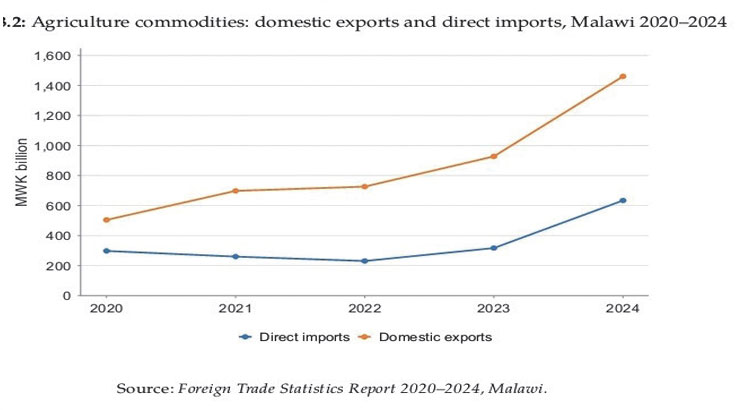
“On the import side, direct agricultural imports averaged K347.8 billion and represented 10.4 percent of direct imports over the study period. In 2024, direct agricultural imports amounted to K633.7 billion, equivalent to 11.4 percent of direct imports.”
Experts have described the situation as a sign that the economy failed to diversify in the past five years and that the agriculture sector is not transforming to achieve value addition to support manufacturing growth.
In an interview on Monday, trade and investment expert Paul Kwengwere said the data shows Malawi’s persistent structural challenge of lack of diversification as the country suffers the impact of overreliance on a single sector that is prone to weather disruptions and fluctuating global commodity prices.
“This situation directly conflicts with the export diversification goals set out under the Malawi 2063. Malawi must shift from rhetorical value-addition to aggressive structural execution,” he said.
Kwengwere, who has previously served as Malawi Investment and Trade Centre former chief executive officer and headed the Economics Association of Malawi, said there is need to capture the processing margins that Malawi currently yields to international markets.
University of Malawi economics lecturer Edward Leman, in an interview on Monday, described the situation as delicate and has since recommended the need to work on the mining and tourism sectors.
“It is a delicate situation for our economy especially considering that the agriculture we are talking about here is rain -ed and barely mechanised,” he said.
Agricultural policy expert Tamani Nkhono Mvula said the dominance of the agriculture sector is a sign that the country is not developing and that large part of the population is linked to primary agricultural activities that are not supporting industrialisation.
“It shows that the country is not developing because the majority of the people are involved in primary agriculture,” he said.
Meanwhile, NSO data show that domestic food exports reached K365 billion or 47.2 percent of domestic exports in 2021 and rose further to K506.8 billion in 2025, reflecting faster growth in non-food domestic exports.